
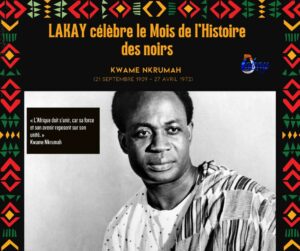
 Kwame Nkrumah (September 21, 1909 – April 27, 1972)
Nkrumah leads his country to independence March 6, 1957, making Ghana the the first nation in sub-Saharan Africa to break free from colonial rule. For millions of Africans, this event is not just a national victory: it is a signal of hope, proof that colonial domination can be overthrown.
His leadership is guided by a deep conviction:
No people can be free while others remain oppressed.
🌍 The father of modern political pan-Africanism
Nkrumah dreamed of a united, strong, and cohesive Africa.
He plays a central role in the creation of the’Organization of African Unity (OAU) in 1963, the precursor to the African Union.
It encourages newly independent countries to cooperate, to achieve economic emancipation and to value their cultural heritage.
For Nkrumah, African unity is not a utopia, but a historical necessity.
🔥 A legacy for the Black world
Kwame Nkrumah remains a symbol of:
- determination,
- strategic vision,
- Black pride,
- resistance to injustice,
- faith in the African renaissance.
His ideas inspired leaders such as Julius Nyerere, Patrice Lumumba, Haile Selassie, and continue to fuel contemporary struggles for social justice, sovereignty, and emancipation.
During Black History Month, his legacy reminds us that freedom is not achieved solely through breaking with the past, but through building a collective future.
✨ Quote inspired by his message
«"Africa must unite, because its strength and its future depend on its unity."»
(Paraphrase inspired by his Pan-African speeches.)